
The Eight Skills
That Matter Most
The human skills that predict who thrives after graduation have always been real. What's new is the ability to measure them with rigor, in a student's own authentic voice.
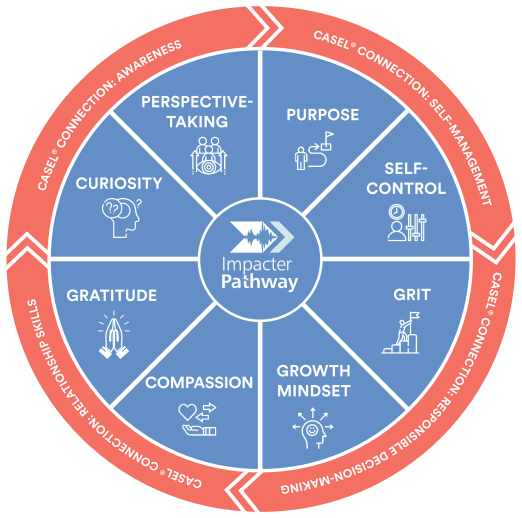
Curiosity, grit, gratitude, self-control and more: one complete framework, from knowing to caring.
Durable skills predict long-term outcomes roughly twice as strongly as cognitive metrics alone.
Built on the research foundation of Harvard's Making Caring Common project.
Four Quadrants, Organized As One Continuous Arc Of Growth
Skills move through four connected quadrants, from knowing, to pursuing, to persevering, to caring. Each rubric-aligned and measured through authentic voice. Click any attribute.
Harvard · Making Caring Common
These attributes are not invented in-house. They're drawn from Making Caring Common, the Harvard Graduate School of Education project led by Dr. Richard Weissbourd that studies the character strengths shaping how young people learn and grow. So what we measure lines up with research districts trust.
Making Caring Common
Weissbourd, Wettje & Ross Anderson — "Definitions of Key Character Terms and Skills" (2020)
Durable Skills Predict Adult Outcomes Better Than Test Scores
Decades of longitudinal research point the same direction. Hover each card for the evidence.
Durable skills like grit, self-control, curiosity, and purpose predict college completion, career earnings, relationship stability, and well-being at roughly double the rate of cognitive metrics alone. These findings hold across socioeconomic backgrounds and demographic groups.
Survey self-ratings are systematically inflated by social desirability bias, acquiescence bias, and coaching. When stakes rise, so does the gaming. Voice is more resistant: students must generate language, not select from pre-written options.
Durable skills leave a fingerprint in language. Word choice, sentence structure, hedging patterns, and narrative framing surface measurable evidence of the anchor skills: richer, more defensible signal than a 45-item Likert survey, in a fraction of the time.
Quadratic weighted kappa of 0.918 against a 0.70 industry threshold. Exact agreement 77.3%, adjacent 98.0%. Every competency benchmarked against expert human raters, with ETS as our validation partner.
"Think about a time you saw a situation very differently from someone else because of who you each are."
A student's spoken answer reveals how they hold more than one point of view at once, the kind of signal a multiple-choice item can never capture.